The Brahma chicken is one of the most majestic and heavy breeds in the backyard poultry world, often referred to as the 'King of All Poultry.' Developed in the United States from large birds imported from China and India in the mid-19th century, this breed played a major role in establishing the American meat and egg industry. Today, Brahmas are beloved by homesteaders for their quiet, gentle temperaments, excellent cold hardiness, and impressive dual-purpose capabilities. In this guide, we will explore their physical characteristics, egg production, space requirements, and the specific care needed for their feathered legs.
Backyard flock owners appreciate the calm demeanor of the Brahma, which allows them to easily integrate into mixed-breed setups without causing pecking order disruption. Their large size also makes them less vulnerable to small hawks, which are often deterred by their sheer mass. Raising these birds is a rewarding experience for anyone who has the space to accommodate them.
Brahma at a glance
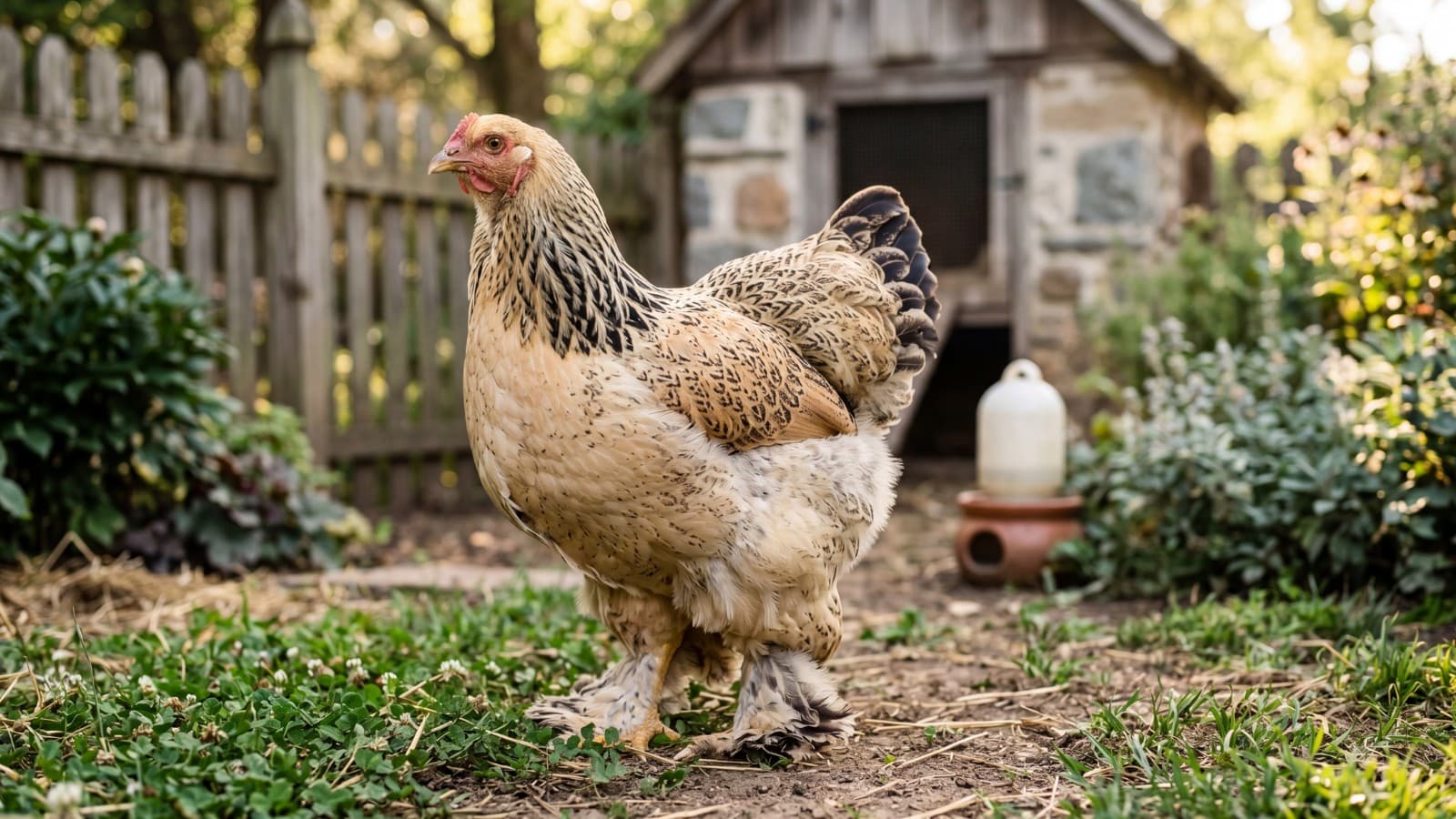
Brahmas are massive, slow-maturing chickens with an upright carriage and a quiet, imposing presence. They feature a small pea comb, which makes them highly resistant to frostbite, and a dense coat of fluffy feathers that extends all the way down their legs to the outer toes. There are three primary color varieties recognized by the American Poultry Association: Light, Dark, and Buff, each displaying beautiful contrasting plumage. Their gentle, trusting personality makes them standout pets, while their heavy weight makes them excellent dual-purpose birds for small farms.
Historically, they were the primary meat bird in America until the mid-20th century. Their quiet clucking and calm disposition mean they fit perfectly in suburban backyards where noise must be kept to a minimum. Because they cannot fly, containment is very straightforward.
Appearance and varieties
Brahmas are defined by their deep, broad bodies and their characteristic 'beetle brow'—a projecting forehead that gives them a serious but gentle expression. Their pea comb is small and sits close to the skull, minimizing exposed tissue in freezing weather. Their plumage is incredibly dense and soft, featuring a tight layer of under-fluff that traps body heat. The Light Brahma has a white body with black-striped hackles and a black tail, the Dark Brahma displays striking silver-gray penciling, and the Buff Brahma shares the Light pattern but replaces the white with a rich golden-buff tone.
Their leg feathering is one of their most prominent features, starting at the thighs and running down the shank to the middle and outer toes. This feathering creates a boot-like look that contributes to their slow, stately walk. Their bodies are wide and deep, supported by thick, strong yellow legs.
Temperament
Known as the ultimate 'gentle giants,' Brahmas have an incredibly calm, placid, and curious temperament. They are rarely flighty and do not startle easily, making them highly suitable for yards with active pets or small children. Because they are heavy and have short wings, they cannot fly, meaning a simple two-foot fence is usually enough to keep them contained. They socialize well with other peaceful breeds and generally occupy a middle-to-high position in the pecking order without resorting to bullying.
They enjoy human interaction and are often the first to walk over when you open the coop door. With a little hand-feeding of mealworms, they quickly become trusting lap-chickens that will happily stand still to be petted. Their patient nature makes them ideal for children learning how to handle poultry.
Egg laying
Brahma hens are dependable layers of medium-to-large light brown eggs. While they do not lay at the rapid rate of modern hybrids, producing around 130 to 150 eggs annually, they are highly valued for their winter production. Their heavy feathering keeps their reproductive tract warm, allowing them to lay right through freezing winters when other hens stop. They are also known to go broody occasionally, making excellent, protective mothers that can easily cover a large clutch of eggs due to their size.
Because they mature slowly, a Brahma pullet may not lay her first egg until she is 28 to 32 weeks old. Once they start, however, their production is remarkably consistent over several years. Their eggs have strong shells and deep orange yolks, especially when they are allowed to forage on pasture.
Size and space needs
This is one of the largest chicken breeds, with mature roosters weighing around 11 to 12 pounds and hens weighing 9 to 10 pounds. Because of their sheer mass, they require more physical space than standard breeds to remain healthy. They do best in a coop with wide doorways, low roosting bars, and spacious nesting boxes. While they tolerate confinement well, they are active foragers that will happily clean up weeds and pests in a pasture if given the opportunity.
Due to their weight, you must ensure that all ramps and doors are wide enough for them to pass through comfortably. They consume more feed than smaller, lighter breeds, which is an important budget factor to consider when planning your flock size.
Climate fit
Brahmas are outstandingly cold-hardy, thriving in northern climates where winter temperatures drop below freezing. Their small pea comb and wattles are rarely susceptible to frostbite, and their thick feathers act as a heavy winter coat. However, their size and density make them highly vulnerable to heat stress. In hot summer weather, they must be provided with deep shade, fresh cool water, and active ventilation. Keep them in a shaded run during hot afternoons to prevent heat stroke.
In humid heat, they can struggle significantly because their thick feathering prevents them from shedding heat. Keepers in southern regions must ensure they have shaded dust baths and cooling fans in the coop. Placing ice in their water bowls on hot afternoons is also highly recommended.
Coop and care needs
- Lower roosts. Heavy birds can hurt their leg joints or bruise their breast muscles when jumping down from high perches. Keep roost bars 18 to 24 inches off the floor to prevent injury.
- Wide nest boxes. Standard 12-inch boxes can be tight for a 10-pound hen. Provide nest boxes that are at least 14 inches wide and deep so they can turn around comfortably.
- Dry run management. The feathers on a Brahma's feet act like sponges, absorbing mud and water. A muddy run leads to dirty eggs, broken feathers, and frostbitten toes in winter.
- Sturdy ramp angles. Keep coop ramps wide and set at a gentle angle so these heavy birds can enter and exit the coop safely without slipping or straining.
Pros and cons
Pros: Extremely cold-hardy and excellent winter layers; calm, gentle, and child-friendly; unable to fly over standard garden fences; dual-purpose for meat and eggs.
Cons: Susceptible to heat stress in summer; feathered legs require extra mud management; slower to reach mature laying age than light breeds; require larger coop and nest box spaces.
Who Brahmas are best for
Brahmas are the perfect fit for cold-climate homesteaders, backyard keepers looking for friendly pet chickens, and anyone who wants a reliable source of fresh eggs throughout the winter. Their quiet behavior makes them ideal for suburban yards, and their calm nature makes them a favorite for families with young kids.
Frequently Asked Questions
Quick, practical answers to common questions about feeding this to chickens.
About the Author

Amy Schmelter is a lifelong chicken keeper raising a large flock in Florida and the author of the upcoming book What I Wish I Knew Before Getting Chickens. She started Chicken Homestead to share what actually works.
Disclosure
Some links on Chicken Homestead may be affiliate links. We only recommend products we’d use ourselves. See our affiliate disclosure for details.